


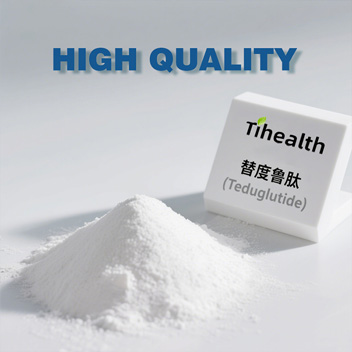
Teduglutide
Teduglutide
Teduglutide
We use our own production line that meets international standards to synthesize high-purity raw materials specifically for pharmaceutical research and clinical applications. Strictly follow impurity c
Send Inquiry
Description
Product Introduction:
Product Name: Teduglutide
Product source: It is a glucagon like peptide-2 (GLP-2) analog
Content specification: ≥ 98%
CAS NO:197922-42-2
The chemical formula is C164H252N44O55S
Molecular weight: 3752.08
Detection method: HPLC
Active ingredient: Teduglutide
Product Description: White to off white freeze-dried powder
Product use: scientific research and pharmacological experiments, as well as short bowel syndrome
Product packaging: 1 gram/bottle; 10 bottles/box (customizable)
Product storage: It is recommended to store frozen at -15 ℃ to -20 ℃ and avoid direct sunlight
Shelf life: 24 months
Products Description
Teduglutide supplied by Xi'an Tihealth
We use our own production line that meets international standards to synthesize high-purity raw materials specifically for pharmaceutical research and clinical applications. Strictly follow impurity control standards and comply with the Chinese Pharmacopoeia and international pharmaceutical raw material specifications. Strong batch stability, residual moisture ≤ 1.0%, endotoxin controlled within ≤ 5EU/mg, ensuring the safety of direct use in formulation production.
This product has been clinically validated to significantly improve intestinal absorption function and help patients reduce their dependence on parenteral nutrition. We provide customized packaging ranging from 1g to kg to assist customers in efficiently advancing drug research and production.
Products Function
Tedroside improves intestinal function by mimicking the action of natural GLP-2 and is mainly used for the treatment of short bowel syndrome (SBS).
Main functions:
Promote intestinal absorption, reduce dependence on parenteral nutrition, and improve intestinal barrier function
Products Application
Indications: Short bowel syndrome in adults and children
Clinical effect: After 24 weeks of treatment, 63% of adult patients showed a decrease in external nutritional requirements, while the remaining patients completely withdrew.
Mechanism of Action
Tedroside exerts the following effects by binding to GLP-2 receptors in the intestine:
Promote intestinal growth: stimulate the proliferation of crypt cells and increase the absorption surface area of the intestine.
Release growth factors such as insulin-like growth factor (IGF-1), keratinocyte growth factor (KGF), and nitric oxide, which can repair the intestinal epithelial barrier and enhance nutrient absorption.
Inhibit gastric acid secretion: reduce gastric emptying, thereby improving intestinal function